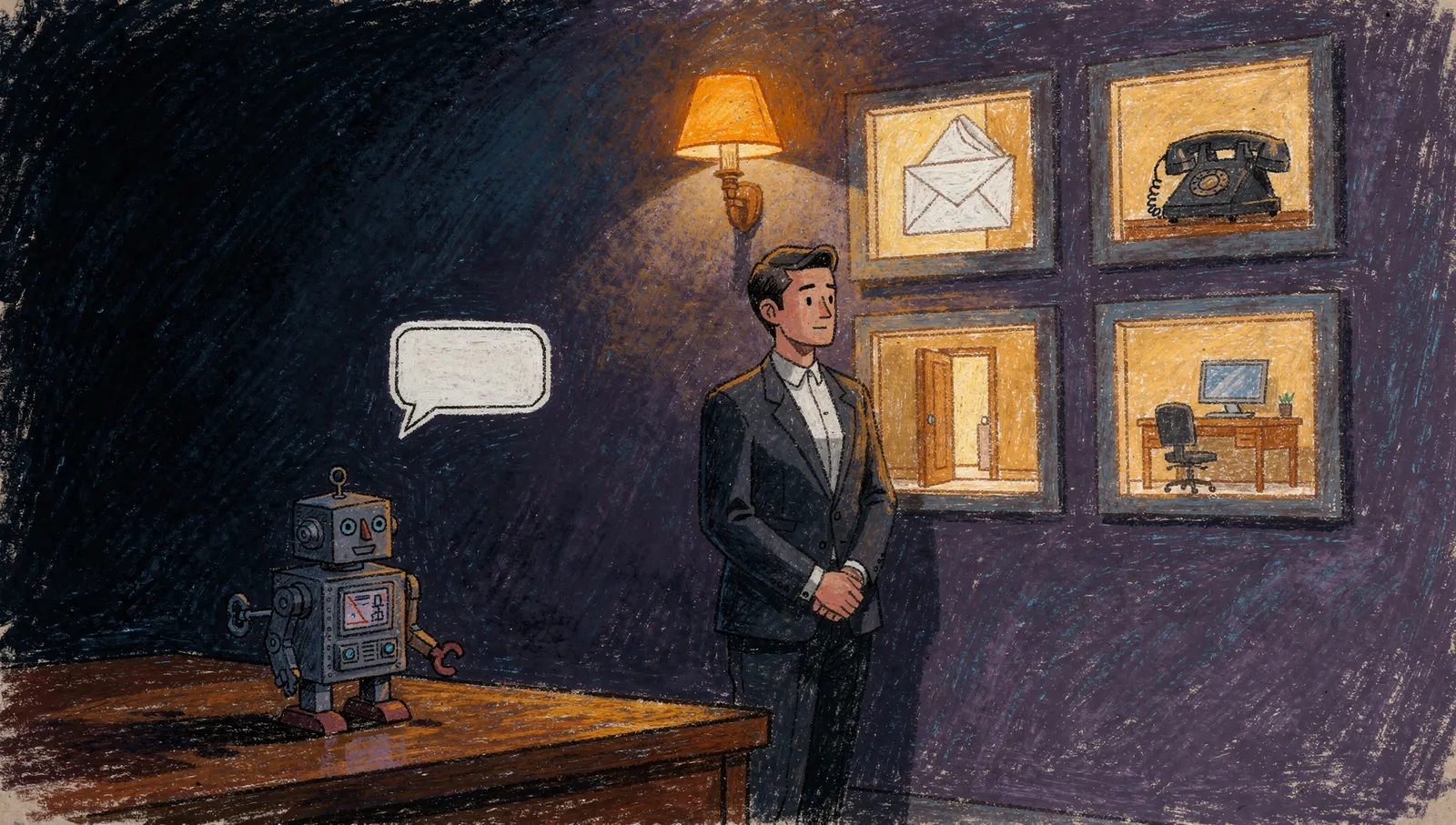
A chatbot is a single-channel answering machine: it lives in the website widget, follows a script or a knowledge base, and succeeds when the visitor goes away satisfied, or just goes away. An AI inbound SDR is a sales function: it works every inbound channel, makes real qualification decisions, scores and routes every lead, and its success is measured in qualified meetings on reps' calendars.
The confusion is understandable, because the chat window looks the same. The seven differences are underneath.
The seven differences
1. One channel versus four
A chatbot exists in the widget. Close the tab and the relationship ends. An AI inbound SDR treats chat as one of four doors: web form, email, chat, and phone all land in the same qualification flow, the same scoring, the same CRM record. The buyer who fills the form at midnight and the one who calls at 9am get the same standard of handling.
2. Scripts versus decisions
Chatbots branch: if visitor says X, show Y. An AI inbound SDR holds an open conversation and then makes a judgment a script cannot: is this a real buyer, is this the right fit, is now the moment. That judgment runs against a qualification policy your team defines, not a decision tree a vendor shipped.
3. Anonymous session versus enriched record
To a chatbot, every visitor is a fresh anonymous session. An AI inbound SDR builds a record: who this person is, what the company is, what live company-signal data says about whether they are likely to be in-market. The conversation is one input; the score is built from more than the conversation. More on that distinction in qualified isn't in-market.
4. Deflection versus pipeline
Most chatbots descend from support tooling, and it shows: the design goal is resolving the interaction without a human. That is the right goal for support and exactly the wrong one for sales. An AI inbound SDR is pointed the other way: its job is to get real buyers deeper in, not to keep people out.
5. Transcript versus CRM write
A chatbot's output is a transcript somebody might read. An AI inbound SDR's output is a CRM record: contact created or updated, qualification outcome logged, score attached, owner assigned, rep notified. If the work does not land in the CRM automatically, it did not happen.
6. Capturing details versus booking meetings
The classic chatbot endgame is "leave your email and someone will get back to you", which restarts the very wait the buyer was trying to skip. An AI inbound SDR finishes the job: it books the meeting with the right rep while the buyer is still warm, and only hands off details when a meeting genuinely is not the right next step.
7. Black box versus audit trail
When a chatbot mishandles a visitor, you usually never find out. An AI inbound SDR worth trusting logs every decision: what was said, what was scored, why a lead was booked, routed, or suppressed. Sales leaders should be able to audit any lead's journey after the fact. If a vendor cannot show you that trail, treat the product as a chatbot with better marketing.
Side by side
| Chatbot | AI inbound SDR | |
|---|---|---|
| Channels | Website chat | Web form, email, chat, and phone |
| Logic | Scripts and decision trees | Qualification policy plus judgment |
| Lead context | Anonymous session | Enriched, scored record |
| Design goal | Deflect, resolve, contain | Qualify and convert |
| Output | Transcript | CRM write, routing, booked meeting |
| End state | "Someone will get back to you" | Meeting on the rep's calendar |
| Accountability | Opaque | Every decision logged and auditable |
When a chatbot is the right answer
Honestly: often. If the goal is support deflection, documentation lookup, or FAQ traffic, a chatbot is the right tool and an AI SDR is overkill. The line is inbound sales volume. Gartner's latest buyer survey puts about two-thirds of B2B buyers preferring a rep-free experience, which raises the stakes on every digital conversation, but it only becomes an SDR problem when hand-raisers arrive faster than humans can honestly qualify them. Under that threshold, a good chatbot and an attentive human beat any automation.
Over it, the gap compounds daily. What full coverage looks like, and how to evaluate the tools that claim it, is in the inbound SDR guide.
Common questions
Is an AI inbound SDR just a smarter chatbot?
No. The difference is scope and output, not intelligence: four channels instead of one, decisions instead of scripts, CRM writes and booked meetings instead of transcripts.
When is a plain chatbot enough?
When the goal is support or FAQ deflection and inbound sales volume is low enough for humans to handle every hand-raiser within minutes.
Do AI inbound SDRs replace live chat tools?
They absorb the sales half: qualifying visitors, answering product questions, booking meetings. Support stays with the support stack. The mistake is expecting either to do the other's job.